 Nov 13, 2026 9:00 AM
Managing Humidity In Cold Weather
PROBLEM: As seasonal temperatures decline and you keep your greenhouses closed to retain heat, humidity management becomes increasingly challenging. Excess humidity can lead to condensation on plant surfaces, prolonged leaf wetness, uneven temperatures and increased disease pressure. At the same time, excessive venting can waste energy and create temperature fluctuations.
JOSH’S TIP: Successful humidity management requires balancing heat, ventilation and air movement to maintain a favorable crop environment while minimizing energy costs and plant stress. Here are the factors you need to know:
Condensation. Relative humidity alone does not determine whether condensation will occur. Condensation develops when plants or greenhouse surfaces cool to the dew point of the surrounding air, which is the temperature at which the RH reaches 100%. During cool weather, glazing, structural components and crop surfaces can become cooler than the air, allowing free moisture to form on leaves. This creates conditions conducive to foliar disease development. Managing humidity is less about maintaining a specific RH and more about preventing condensation and subsequent leaf wetness.
Cool Weather. Warm air can hold more water than cool air. During the day, crops and substrate release moisture into the greenhouse through evapotranspiration. As temperatures decline overnight, relative humidity rises and the potential for condensation increases. Since greenhouses are typically closed to conserve heat during cool weather, moisture can accumulate inside the structure. Without adequate air movement and ventilation, the air can approach saturation by morning, particularly in cool, stagnant areas of the greenhouse.
Heat & Vent. Heating and venting may seem like opposing actions, but they can be effective when used together. Heating raises the air temperature and lowers relative humidity, providing an opportunity for moisture to evaporate from plants and greenhouse surfaces. Cracking the ventilation then exchanges the warm, moisture-laden greenhouse air with cooler outside air in a process often referred to as “burping” the greenhouse. Used strategically, heat-and-vent cycles can remove moisture while limiting the energy loss associated with leaving vents open for extended periods. Optimal RH targets depend on temperature setpoints, with RH increasing by about 2% for every 1 degree F drop in temperature.
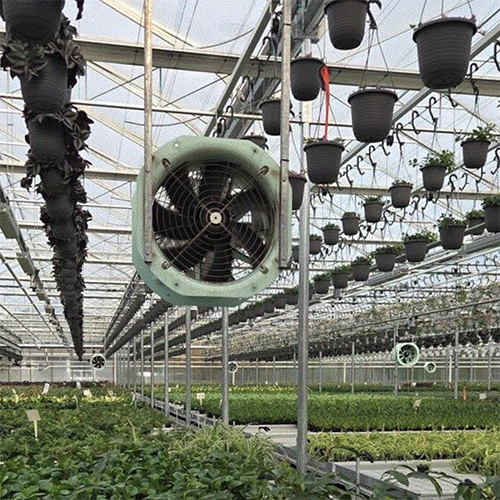
Horizontal air flow (HAF) fans help mix the air to distribute humidity.
Air Movement. Greenhouse climates are rarely uniform. Microclimates with cooler temperatures and higher humidity can develop near sidewalls, corners, doors, curtains and crop canopies. HAF fans help mix air throughout the greenhouse, reducing temperature and humidity differences between these areas. Consistent air movement also helps moisture evaporate from plant surfaces. However, HAF fans do not remove moisture from the greenhouse, so air movement needs to be combined with appropriate ventilation when moisture levels become excessive.
Crop Management. Environmental controls are only part of humidity management. Dense canopies, close spacing and excessive irrigation can increase humidity around the crop and extend drying time. As crops mature, airflow through the canopy can decline and foliage may remain wet longer after irrigation. Watering earlier in the day provides more time for foliage to dry before temperatures decline at night, while proper spacing helps improve air movement through the canopy and promotes uniform drying.
Energy Balance. The goal is not to maintain the lowest possible humidity. Excessive ventilation can increase heating requirements without necessarily improving crop quality. Instead, you should focus on preventing condensation and extended leaf wetness while maintaining reasonable energy efficiency. Combining sufficient air movement with appropriate irrigation timing and strategic heating and ventilation can help maintain a more uniform crop environment during cool weather.